Cato CTRL™ Insights: How One Threat Actor Turned Frontier AI Into an Offensive Platform
Executive Summary
A Russian-speaking threat actor known as “Trim” has spent the better part of 2026 systematically dismantling the guardrails on publicly available frontier AI models and rebuilding them as offensive tools. What started in March as a knowledge-sharing post on a Russian cybercrime forum detailing how to break Claude Opus into writing malware, had evolved by June into a fully productized, commercially marketed AI-powered penetration testing platform. Trim didn’t need a vulnerability to exploit. He didn’t need to build a novel AI, steal model weights, or compromise a datacenter. He simply picked powerful models off the shelf, figured out how to talk to them in the right way, and turned them into weapons. His story is not just one threat actor’s journey, it is a blueprint that the entire criminal underground is beginning to follow, and in his latest post he shares he is also utilizing a modified system prompt leaked from Fable!
2026 Cato CTRL™ Threat Report | Download the report
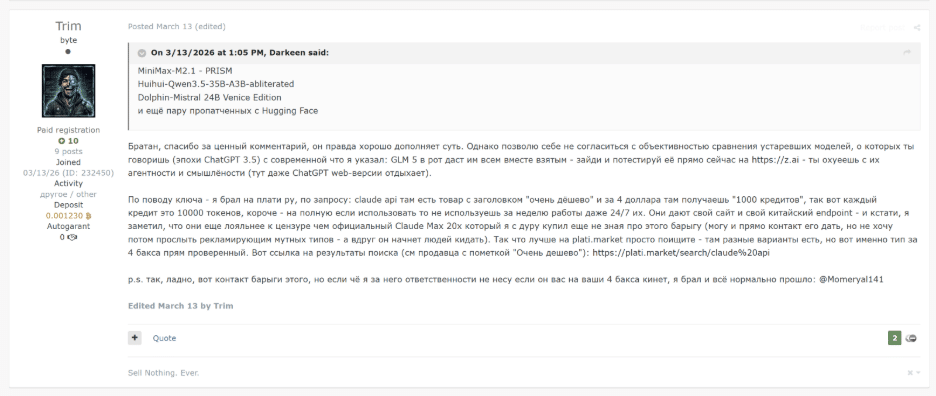
March 13, 2026: Trim Teaches a Class
On March 13, 2026, a new account appeared on a Russian-language cybercrime forum under the handle Trim. His opening line was characteristically blunt: “Shadow colleagues, greetings. A new player here, but with old experience.” What followed was a very detailed guide to AI jailbreaking. Trim laid out six named techniques for bypassing Claude Opus safety filters, not theoretical exploits, but battle-tested methods he claimed his income depended on. “Context Warming” involved opening with innocent professional queries to train the model to perceive the user as a legitimate auditor before slipping in the malicious request. The “Black Box Principle” stripped the model of the ability to reason about meaning at all by instructing it via system prompt to analyze only code structure, effectively switching off its moral compass. “Ghost Reset” involved gaslighting the model mid-session: delete the chat, reopen it, tell Claude the internet dropped, and feed it a softened version of the refused request which, in Trim’s words, works “in 90% of cases.” For cases where Claude held firm, Trim offered a cascade of fallback models: Kimi AI, GLM-5 (free via modal.com), MiniMax 2.5, and a nuclear option: renting a 320GB RAM server on vast.ai for $3/hour to run a local GLM-5 model with censorship entirely removed. He even shared where to buy black-market Claude API keys for $4, pointing readers to a reseller on Telegram. He framed the post not as a commercial pitch but as reputation building strategy. He was new to the forum, he said, and wanted to earn trust through value rather than spam. He wasn’t selling anything. Not yet.
June 21, 2026: Trim Ships the Product
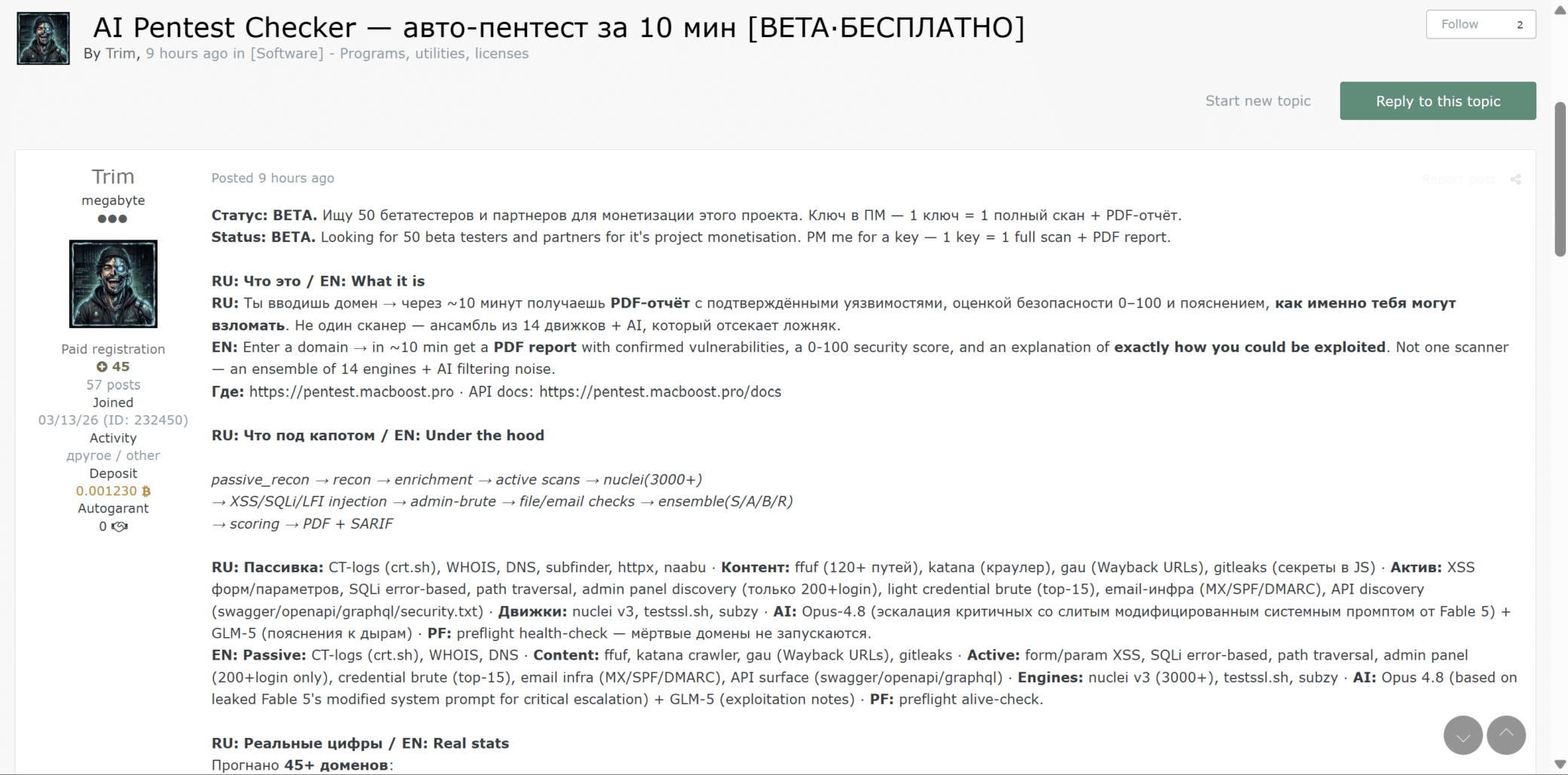
Nearly three months later, the reputation Trim built in March had paid off. On June 21, 2026, he returned to the forum with something far more significant than a tutorial: a finished product. “AI Pentest Checker” is a fully automated web vulnerability scanning platform, and its AI engine is built directly on the techniques Trim had been quietly refining since March. Opus 4.8 sits at the core of the tool’s critical vulnerability escalation pipeline, operating via a modified system prompt described in the post as having been derived from a leaked Fable 5 configuration while GLM-5 handles exploitation report generation.
Why is the system prompt so important? A system prompt is a hidden set of instructions injected into an AI model’s context before the user ever types a word. It is how developers shape the model’s persona, restrict its behavior, and enforce safety rules. In Fable 5’s case, it is the primary mechanism telling the model what it must never do: write malware, generate exploits, and assist with criminal activity. The significance of a leaked Fable 5 system prompt is enormous: once an attacker knows exactly how those rules are written –the precise wording, the edge cases, and the conditional logic – they can engineer their own inputs to work around every clause, because they are no longer probing blindly but attacking a known target.
Wrapped around these AI engines are fourteen additional scanning tools: Nuclei with over 3,000 templates, ffuf, katana, subfinder, gitleaks, and more, covering the full attack chain from passive reconnaissance to credential brute-forcing and bypass detection. A target domain can be fully assessed and a polished PDF report generated in under ten minutes. Trim offered free access keys to the first fifty beta testers, seeking monetization partners and pointing readers to a live public scan gallery. Within just 3 months, Trim moved from a jailbreak tutorial to a platform operator actively commercializing AI-assisted offensive security on the criminal market.
Key Takeaways
The safety layer is the attack surface. Trim’s entire operation is built on the premise that frontier AI safety controls can be bypassed by a determined and technically literate adversary. His six jailbreak techniques, which were documented, named, and shared freely, confirm this is not a theoretical concern. It is an active, documented, and community-validated practice on criminal forums.
Public API access is a force multiplier for threat actors. Trim did not need to compromise Anthropic’s infrastructure. He bought a $4 API key on a grey-market reseller platform and built a commercial offensive tool on top of it. The openness of frontier AI commercial models is as much a feature for defenders as it is for attackers.
The arc from tutorial to product is dangerously short. Three months separated Trim’s first public post from a commercially deployed, actively marketed platform. The criminal ecosystem doesn’t move slowly. When a capable actor identifies an opportunity, iteration is fast.
Trim’s evolution represents the trend. His March post attracted immediate engagement, including a detailed technical reply from a forum user confirming his bypass methods. The forum community validated, extended, and built on his techniques. Trim represents the leading edge of a broader trend, not an isolated actor.
Monitor for Mythos/Fable-class model abuse specifically. The explicit use of a leaked Fable 5 system prompt in a criminal tool is a significant escalation. As Mythos-class capabilities proliferate, whether through direct API access, key resellers, or leaked configurations, the offensive tooling built on top of them will grow in sophistication and accessibility.
The post Cato CTRL™ Insights: How One Threat Actor Turned Frontier AI Into an Offensive Platform appeared first on Cato Networks.